
Institute of Civil Engineering
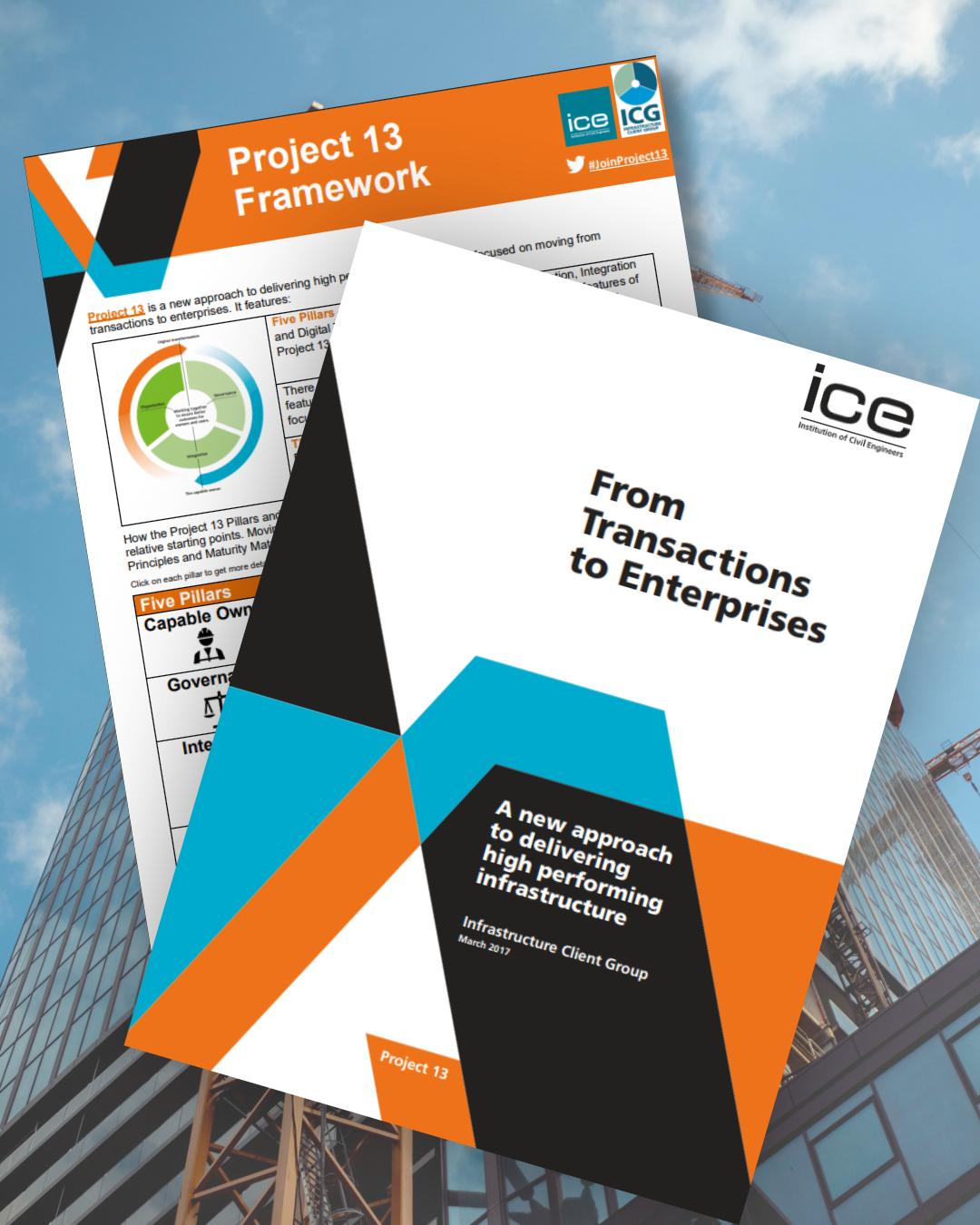
Project 13 was established as an industry-led response to the persistent shortcomings of traditional infrastructure delivery models. Built Confidence’s Hannah Vickers played a central role in the creation of Project 13, helping to develop the programme’s strategy, authoring key guidance, including the Commercial Handbook and Blueprint, and securing participation from 13 major infrastructure clients.
Built Confidence’s Hannah Vickers played a leading role in the development and delivery of Project 13, leading the ICE Policy and Public Affairs Programme and coordinating the Infrastructure Client Group.
As the author of both the Project 13 Commercial Handbook and the Blueprint, Hannah helped to shape the programme’s foundational strategy and negotiated participation from 13 major clients.
We look at how Project 13 redefined delivery models for major infrastructure, the five pillars underpinning the new enterprise approach, and the continued relevance of Project 13 to those seeking to develop delivery strategies for complex or innovative major infrastructure programmes.
What is Project 13?
Project 13 is an industry‑led response to long‑standing failures in traditional infrastructure delivery models. Government-led projects historically suffer from cost and time overruns, with dysfunctional transactional relationships that promote decisions driven solely by cost.
Project 13 sought to develop a new business model, replacing transactional, cost-driven procurement with an enterprise model. The new model aligns incentives and integrates delivery teams, improving certainty, productivity and whole-life outcomes. This industry-led innovation worked toward building a community of owners and suppliers committed to systemic change.
The Approach
Project 13 replaces fragmented, adversarial contracting with integrated enterprises aligned around shared outcomes. The new model created key shifts in approach:
Direct relationships between owners, suppliers and advisers, facilitated by an integrator
Integration of capabilities, processes and information from all partners
Opportunities for early engagement and strengthening of delivery relationships, involving suppliers when they can add the most value
Risk allocation aligned to capability rather than pushed down the supply chain
Reward centred on value added to overall outcomes
Early adopters of the new model included Anglian Water alliances delivering £500m/year, Environment Agency collaborative supplier arrangements, Heathrow Airport expansion and National Grid’s London Power Tunnels.
The Five Pillars of the Project 13 Approach
1. Governance
Infrastructure owners establish the rules, processes and practices that guide interactions and decisions.
2. Organisation
Owners must engage the right suppliers at the right time and integrate them into the team.
3. Integration
Owners develop the culture, practices and systems appropriate to the programme being delivered.
4. Capable Owner
Owners must define outcomes, articulate technical requirements, manage stakeholders, and collaborate across the enterprise.
5. Digital Transformation
Organisations must devise new business models to integrate and embrace new technologies, changing how they operate.
Outcomes → From Transactional to Collaborative: Implications for Clients Developing Delivery Models
Traditional procurement has the potential to create fragmented teams, misaligned incentives and adversarial relationships. Project 13’s research demonstrated that these models:
Drive short‑term cost decisions
Undermine productivity
Limit innovation
Increase delivery risk
In response, the new enterprise model promotes early supplier engagement, shared risk ownership, integrated decision-making and commercial incentives for collaboration to jointly mitigate risk.
Organisations developing new delivery models – particularly for FOAK technologies, major programmes or digitally enabled infrastructures – can realise significant benefits from following Project 13’s approach.
Relevance to Today’s Clients
The challenges Project 13 addresses remain prevalent across UK infrastructure, from fragmented supply chains and low productivity to misaligned incentives. The blueprint can be invaluable for those seeking scalable delivery models, such as for fleet programme application, prioritising long-term value and whole-life performance.
Project 13’s principles are particularly relevant for clients in emerging or rapidly transforming markets such as advanced nuclear and energy transition. In nascent markets with complex supply chain requirements and overlapping technology streams, building collaborative supply chain ecosystems and embedding long-term thinking from the start is critical.
Built Confidence’s advisory and strategy services draw heavily upon Project 13’s principles, adapted and applied individually and effectively to different projects. We can help clients to:
Define enterprise roles and governance requirements
Design commercial models that reward value
Establish capable owner functions
Integrate suppliers and advisers into coherent delivery systems
For organisations seeking a systems thinking approach, Built Confidence can support clients through organisational transformation, turning complex industry programmes like Project 13 into practical delivery frameworks.