
STRATEGY

During her time at HM Treasury, Built Confidence’s Hannah Vickers led the government’s Project Initiation Routemap team, working towards providing a proven, evidence-based method for establishing the foundations of successful delivery.
We explore how this expertise and Routemap-based approach can take your idea from insight to delivery confidence.
Major project delivery is well known for its complexity. Cost and schedule overruns are commonplace, and early decisions can cause issues decades into a programme. Projects hinge on layered risk profiles and poorly understood capability requirements. Success requires the integration and coordination of large, diverse supply chains.
These fundamental pillars of delivery need to be managed appropriately and efficiently from the early stages of a project to increase the likelihood of success and avoid common pitfalls seen across the UK’s major project portfolio.
The Project Initiation Routemap provides a proven, evidence-based method for establishing the foundations of successful delivery. Built Confidence brings deep expertise in this approach, drawing on experience leading the UK Government’s Routemap team within HM Treasury, where the methodology was developed, refined, and applied to some of the country’s most complex programmes, such as Sellafield and Crossrail 2.
Our Approach
Built Confidence works with Chief Executives, Senior Responsible Owners, and cross-functional delivery teams to test delivery readiness, identify capability gaps, and shape the strategic architecture of major programmes before key investment decisions are made.
Our approach is grounded in the practical experience of leading HM Treasury’s Project Initiation Routemap team, where the framework was used to strengthen delivery confidence across a portfolio of major programmes totalling over £200bn. That experience now underpins the service we offer to clients embarking on complex programmes.
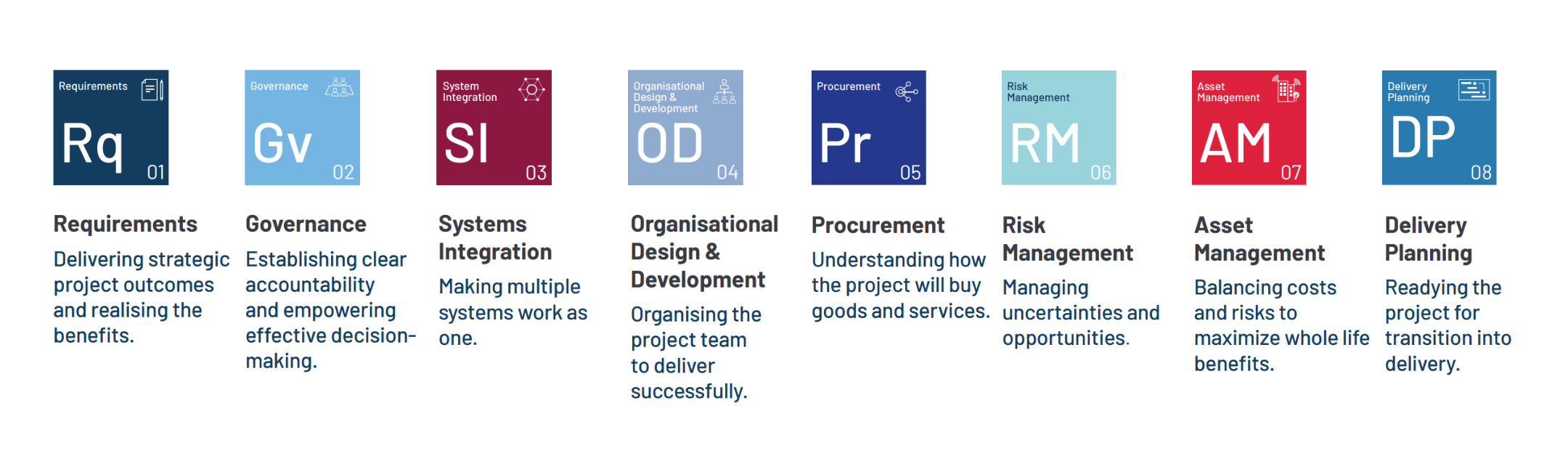
Infrastructure and Projects Authority - Project Initiation Routemap Modules
The Routemap is a structured process that draws on resources from across the Government’s major project portfolio, considering capability across people, processes, systems, governance and ways of working.
It enables learning to be applied during initiation, ensuring that mistakes from previous programmes are not repeated. The approach can be tailored to each project, depending on the programme's scope and development, with 10 key areas of good practice available for consideration.
Our approach is designed to bring key stakeholders together to help identify and manage challenging problems during the early stages of project development. Early collaboration helps to mitigate risks and ensure alignment across the supply chain.
Early Diagnostic Insight and Delivery Risk Assessment
A structured assessment across governance, commercial strategy, capability, and delivery readiness provides a clear, evidence-based view of risk. The early diagnostic exercise profiles the risks and complexity specific to each programme and maps client, market, sponsor and asset manager maturity. The result is a unique profile and gap analysis that can be used to strengthen the programme.
This surfaces:
where capability is strong,
where gaps or misalignments would undermine delivery,
and where lessons from previous major programmes need to be applied.
The diagnostic provides senior leaders with a clear, evidence-based view of delivery risk before committing to scope, cost, or schedule, enabling informed decisions at the point they matter most.
This approach was applied extensively while leading the routemap team in HM Treasury, delivering 22 major programme assessments, including Sellafield, Crossrail 2, Anglian Water, UK Ministry of Defence infrastructure procurement, and the Olympic Park redevelopment.
Designing Capability-Led Delivery Plans
The Routemap emphasises capability over aspiration. Built Confidence works closely with programme teams to design delivery plans grounded in real work experience and lessons applied from other major projects. Utilising the relevant areas from the Routemap’s ten key project modules, programme complexity can be appropriately aligned with supply chain roles, responsibilities and commercial strategies.
This includes:
clarifying client-side roles and decision rights,
collaborating with key stakeholders to identify capabilities and appetite for risk,
strengthening strategic and technical control where it is critical for value,
and shaping delivery models that match the scale, complexity, and risk profile of each programme.
The result is a delivery architecture grounded in realism and evidence rather than inherited assumptions for optimism bias.
Outcomes → From Insight to Delivery Confidence
Built Confidence’s Routemap approach strengthens delivery confidence by:
providing early, evidence-based insight into delivery risk,
aligning capability to ambition before investment decisions,
improving governance, commercial strategy, and organisational readiness,
and embedding lessons from previous major programmes into new ones.
Programmes gain stronger governance, clearer scope, and more credible delivery plans, building confidence and reducing risk before they escalate. The result is an aligned supply chain and a clear vision for delivery.
Relevance to Today’s Clients
Built Confidence now offers this Routemap-based approach as a core Strategy service, helping organisations:
diagnose delivery readiness at programme inception,
design capability-led delivery models,
and establish the strategic foundations for successful major projects.
For clients embarking on complex programmes, the Routemap provides a structured evidence-based pathway to build credibility, reduce risk, and set delivery up for success from day one.